Showing posts with label February. Show all posts

Monday, March 2, 2026

Rain, Humidity & Heavenly Perfume ... My Dry Tropics Garden Journal ... End of Summer ... Week 9, 2026

Garden Journal Entry - Week 9 catch-up
(a two-month wet season recap)

Weather Report for both January & February:

Seasons:  End of Summer / Mid Wet Season 
Maximum Temps:  25°C - 36°C            
Minimum Temps:  20°C - 27°C
Humidity Levels:  70 - 90%   
Hours of daylight:  12 hrs 30 mins
Rainfall: 1011 mm (around 40 ins) - over 40 days across two months


The new gardening year started with a drenching — here in the foothills of our rural suburb, over 200 mm (around 8 inches) of rain fell in just 24 hours on the very first day of 2026. Almost instantly, little streams and tiny waterfalls popped up all around our property as the already sodden ground struggled to absorb the downpour. 


On our sloping block, that meant a surprising amount of run-off: water finding every low point, carving temporary channels, and reminding me (again) that wet season gardening isn’t just about the plants — it’s about the land itself and how it moves water.  Work continued throughout the start of the year on the creation of diversion banks and channels along our fence line to allow the wet season run-off to flow onto the bush paddock without causing erosion in our front yard.


Wet Season 2026

The runoff channels / diversion bank work

Compared to ...

Wet Season 2024

The front yard being carved up by the wet season deluge


The months of January and February in my coastal dry tropics garden are always a bit of a paradox: this is the time of year when everything looks like it should be thriving, given the amount of rain … and yet it’s also when you discover which plants only ever loved you in the mild months.


Summer 2026 brought the full wet-season energy to Townsville - hot, humid, and oppressive conditions with excruciatingly high daytime temps., very warm nights, exceedingly steamy mornings, short and intense afternoon thunderstorms, sudden downpours that feel like someone tipped a bucket over the sky, and that familiar rhythm of “it’s fine… it’s fine… oh wow, it’s really not fine.”


The sound of rain on the corrugated tin roof after a long dry season is one of my favourite sounds
... but the initial love does fade during a lengthy wet season!


The weather story (aka: why the pots sulked)

Looking at the Townsville Aero Weather Station daily observations, January 2026 delivered a hefty 657.2 mm (26 ins.) of rain in total, with a biggest daily fall recorded at 223.0 mm (9 ins.). That’s the sort of month where you stop “watering” and start “triaging.”


February stayed firmly in wet-season mode too, with 353.8 mm (14 ins.) recorded for the month. Still humid, still lush, still plenty of moisture around - just with a little more breathing space between the soaking events.


In the garden at my place, that translated to:

  • potting mix staying wet for days (even the “free draining” stuff)

  • leaves and mulch that never quite dried out, especially in crowded corners

  • fungal spots and stem rot waiting for one overcast week to make their move

  • and that tricky combo of heat + humidity where plants can look fine… right up until they don’t!


One of the potted plants moved to the "Wet Season Triage Corner"
- a soggy pot, a rotting plant, and lots of lovely mould 


The reality check: garden time was… patchy

One of the most defining things about January and February this year (and most years) wasn’t just what the wet season did to the plants - it was what it did to my ability to be out there with them.


Time in the garden was limited by the lengthy (and sometimes very heavy) periods of rain, the muddy, slippery sections underfoot, and the kind of high humidity that turns a quick potter into an instant sweat-soaked expedition. On many days it wasn’t so much choosing when to garden, as waiting for a small weather window to appear.


Whenever it was possible to get out into the garden - usually early mornings or late afternoons - I kept the jobs simple and sensible. This was not the season for big projects or major reshuffles. Most visits came down to two things:

  • Weedingbecause wet season weeds do not take days off, and

  • Monitoring plant health, especially anything in pots or anything showing early signs of stress - yellowing, spotting, limp growth, or stems that felt a little too soft for comfort.


And honestly? That kind of slow, watchful gardening suits this season. In a wet tropical summer, the garden is doing a lot without you - growing, flowering, recovering, sometimes struggling - and your job is mostly to notice and respond when and where you can.


The casualties: Impatiens and Coleus (my annual wet-season lesson)

This year’s wet-season losses were mostly in pots - Impatiens and Coleus, in particular. They’re such generous colour-givers… but in prolonged humidity and repeated rain, potted plants can go downhill fast. Wet feet, softened stems, and that moment where you realise the plant hasn’t “wilted”… it’s collapsed.


My big takeaways (yet again!): in a Townsville summer, pots need airflow, height, and escape routes.  I always forget how quickly pots can turn in this weather ... I should know better.

  • Lift pots so they can drain freely (feet, bricks, anything)

  • Thin out crowded plantings so leaves actually dry

  • Accept that some soft-stemmed beauties are basically wet-season annuals (even when the label says “perennial”)

Next wet season I'm going to pretend I'm organised and actually do the airflow pruning earlier!!!!! 😉

The real headline of Jan–Feb:  Perfume ... everywhere!

While these last two wet season months have been a stress test, as usual, they have also given me the loveliest reward: fragrance, drifting through the garden in waves - sometimes creamy, sometimes sharp-green, sometimes sweet and nostalgic.  Because garden visits were brief and weather-dependent, the perfume wafting throughout the garden felt even more vivid - like the garden's way of greeting me the moment I stepped outside.


Gardenia ‘Soleil d’Or’

Gardenia mutabilis 'Soleil d'or" in full bloom
- the highly scented blooms open white, turn yellow, and then finally gold as the flowers mature

This was the star - that rich, buttery gardenia scent that feels almost textured. Some days it floated on the air all around the driveway and pathway entrances to our house; other days it was concentrated and heady, like the whole garden was wearing perfume. In the wet-season humidity, fragrance seems to hang around longer, especially in the evening.


Jasmine

Jasmine grandiflorum, commonly known as the Poet's Jasmine
- this vine has lots of very fragrant large single flowers

Jasmine in summer is like a soundtrack you don’t realise you’ve been missing until it starts again. It’s lighter than gardenia but it carries - and when the air is still after rain, it can travel from out in the courtyard (where it's planted) through to all the rooms at the back of the house.


Murraya paniculata 

Murraya paniculata (commonly known as Mock Orange or Orange Jessamine
- this tall-growing shrub is covered in beautifully scented white flowers

Murraya has its own kind of magic - a clean, sweet, citrusy-floral scent that reads as “freshly washed air” to me. When it’s flowering well, it’s the plant that makes you pause without thinking: you just stop because something smells good.  They grow all around the house and throughout the garden, creating a heavenly perfume wherever you walk.


What I love about this season (even with the soggy setbacks)

There’s something very dry-tropics about finding joy in the between moments: that short window after a storm when everything is dripping, birds and butterflies are busy again, and the garden smells like leaves, wet mulch, and flowers all at once.


Yes, I lost a few potted plants. But the trade-off was a garden that, for weeks on end, was scented by Gardenia, Jasmine and Murraya - not just occasionally, but daily. A true wet-season gift.


Notes to self for next summer

  • Keep the “softies” (Impatiens/Coleus) in higher, breezier spots 

  • Treat them as seasonal and take cuttings in the cooler months so more plants are established, ready to replace the lost mature ones

  • Refresh potting mix before the worst humidity hits

  • Prune for airflow earlier (before the garden turns into a jungle)

  • Always plant something for fragrance, because it changes how you feel in the garden


End of Summer Colour & Interest


Around the courtyard
- Ferns, Caladiums,  Eucharis grandiflora (Amazon Lily) and Jasmine


Under the pergola in the courtyard garden
- Allamanda, Ferns, Coleus, Impatiens, Begonia


In the shade house garden
- Impatiens, Ferns, Coleus, Caladium, Alocasia, Evolvulus 


In the outdoor garden beds
- Hymenocallis, Gloriosa, Croton, Turnera, Lagerstroemia, Mussaenda, Ixora 


Closing Thoughts


As February rolled toward its end, it felt like summer was loosening its grip - not in any dramatic way, but in small shifts: a touch more breathing space between the downpours, a slightly softer edge to the afternoons and evenings, and a garden that has proven to be both resilient and ruthless.


We're heading into early autumn with fewer pots than I started the summer with, a sharper eye on plant health, and a deep appreciation for the true heroes of these past months - the gardenia, jasmine and murraya - whose perfume turned even the muddiest, most humid wet-season into something memorable.


Until next time,
🌸 Happy gardening from the dry tropics!


Saturday, March 15, 2025

Variable Wet Season Weather & A Surprise From Mother Nature ... My Dry Tropics Garden Journal, Beginning of Autumn, Week 11, March 2025

Garden Journal Entry - Week 11

This week's weather:


Seasons:  early Autumn & Wet Season
Daytime Temps:  29°C - 34°C            
Night Time Temps: 23°C - 25°C
Humidity Levels: 70 to 90%     
Hours of daylight:  12 hours 15 mins
Rainfall:  76 mm  (3 inches) 


A February To March Update

After nearly a month's break from my online garden journal, it's time to catch up on what's been happening in my garden from mid-February to mid-March (end of Summer and start of Autumn).  These past few weeks have been a whirlwind of weather events, with a setback or two, and a visit from a beloved family member.  Amidst all of this, there has been some progress out in the garden, and a lesson or two learned. 


Battling Heat, Heavy Rain and Humidity  (the usual summertime conditions)


The biggest challenge this past month (& the previous two months) has been the wet season conditions.  There is never a 'typical' wet season, so every year it's like starting over anew, awaiting whatever Mother Nature has in store!  Just because the rain finally makes an appearance in the summertime, that doesn't mean pleasant weather has arrived and it's paradise outside.

February this year brought record-breaking heat.  The day after I published my last garden journal blog post, the daytime high soared to 37.7°C, which ended up being the hottest day in the month of February, about seven degrees above average  (highlighted in red print and red background in the table below).


Weather Information for the Last Two Weeks of February 2025

Following that excruciatingly hot day, the daytime temps. sat up around 32 / 33 °C for the remainder of February.  With the high daytime humidity levels usually sitting round 60 to 70% as well, it felt more like 37°C each and every day for the last two weeks of February.  Some called it a "heatwave", but locals just called it "summer"!   


The conditions made gardening nearly impossible, except for very, very brief early-morning and late-evening sessions.


The intense UV rays made it even trickier for me, as I manage skin cancer issues and need to be cautious with sun exposure.  


The UV Index sat at 'high' to 'very high' by 8.00 am every morning and then shot up to 'extreme' by 10.00 am.  At that rating level, most people need to apply sunscreen every 15 minutes to protect their skin from harmful UV radiation.  I need to retreat indoors!


After the record-breaking rain that fell in early February, rain continued to fall to the end of that month resulting in a total of nearly 1200 mm / 47 inches, making February 2025 the wettest ever on record in our region.


The start of March, and the start of our Autumn, saw a short break in the rainfall, but not the heat.  We have seen record daytime highs continuing, along with the oppressively high humidity levels.


Weather Information for the First Two Weeks of March


This past week has seen the return of rain, usually arriving in the afternoons after stifling, sweltering mornings.  These afternoon showers and the cool breezes that have followed bought about noticeable changes in temperatures at the end of the day.


While the rain over this last week has provided relief at times from the heat, the rain over this whole wet season has caused hurdles for the garden which need continued attention - waterlogging, nutrient leaching and soil compaction.


Visitor Stay


A delightful interruption came in the form of a visitor who ended up staying longer than expected.  His return home flight was cancelled a couple of times, because of an impending cyclone that was expected to cross the coast down south near our state's capital city, near his home.  Whilst that caused him some concern, we were glad his stay continued a little longer than planned.  Thankfully, Cyclone Alfred caused little trouble at his place!

While the visitor's stay paused my gardening activities, it offered a welcome break filled with leisurely breakfasts, local explorations, and insightful conversations.  It was wonderful taking the time to create new treasured memories.


Dealing With Injury


Just as I was getting back into the swing of things, I injured my knee, forcing another gardening hiatus.  Even simple tasks like weeding had to be put on hold.  It was a frustrating setback, but it reminded me that garden maintenance can become a little more difficult as one ages, requiring a deal of patience and forethought when it comes to the lifting and moving tasks that are often required.  


Garden Progress Amidst All Of This:


Pruning and Cleanup


The excessive rain encouraged rapid plant growth, resulting in some plants becoming leggy and weak.  Constant downpours also caused branches to snap or break off entirely.  Once the rain eased, the sudden full-sun exposure scorched leaves, adding to the damage.

To counteract this, I focused on pruning - removing damaged parts to promote healthier, stronger regrowth.  My other half and I tackled the fallen branches and green debris, overfilling a large trailer before taking it all to the local waste facility.


Another major task was clearing out overgrown ferns in one section of the shade house garden.


Thankfully, they were easy to pull out, though I still managed to fill five wheelbarrows with the debris so it became a bigger job than expected!


Once cleared, I added a fresh layer of mulch to help retain moisture for the coming dry season and suppress further overgrowth.


I also moved some of the potted plants around to give the spaces a bit of a re-vamp.


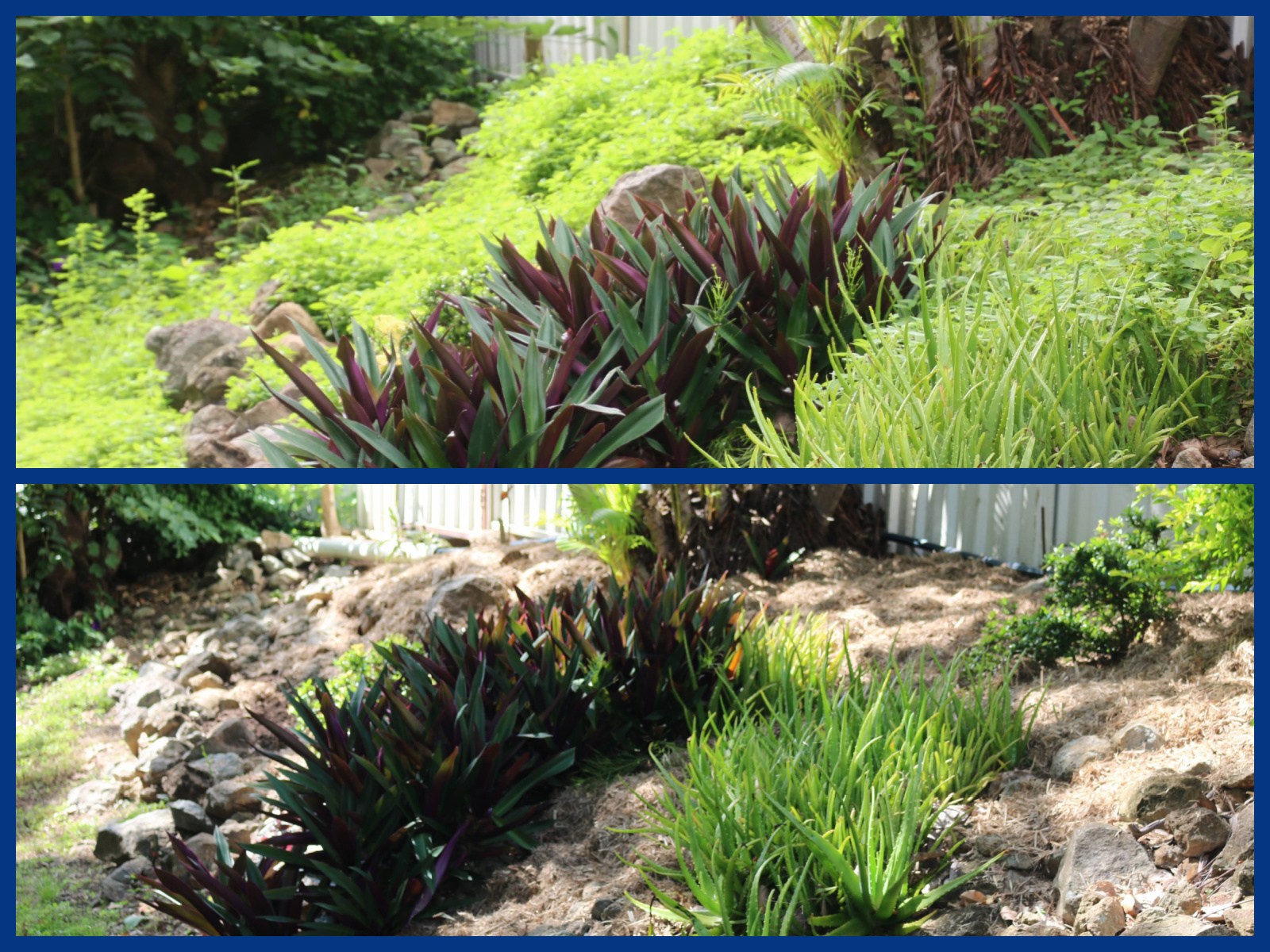
Driveway Garden Makeover


One of the most noticeable improvements was the completion of the weeding and mulching job on one section of the long driveway garden beds.  The difference is striking.  The photos above show just one end of this section.   You can see just how lush the weed growth was in the top photo and what the rocky garden bed looks like now it's cleared of all those noxious weeds.  


This end though remains a bit of a challenge - the rocky, exposed area has proven difficult for plant success.  I've tried hardy plants like Russelia, Crotons and others over the years, but nothing has thrived.  Leaving it bare isn't an option, so I'll need to do some thinking and planning.  I want something that will provide colour, will survive in full sun, will grow in poor soil and won't take over the space completely.


Soil Restoration and Nutrient Boosting 


The record rainfall received this wet season has taken a toll on soil quality, particularly in the courtyard garden beds, washing away essential nutrients.  To remedy this, I have applied a top dressing of general-purpose fertiliser with trace elements.


In areas where the rain had caused severe soil compaction, I have added nutrient-rich soil to restore balance.


Fascinating Plant Adaptations


One of the most intriguing observations from this wet season has been the response of certain plants - Acalyphas, Coleus and Begonia - to the prolonged moisture.  They began producing aerial roots, likely as an adaptation to oxygen-deficient conditions caused by waterlogging.  This natural survival mechanism helped them absorb additional oxygen and moisture, a fascinating reminder of how resilient plants can be.


Looking Ahead:  Next Steps In The Garden

As we move through March, my focus will be on:

Re-potting plants affected by the wet season
Continuing soil enrichment to restore lost nutrients
Further pruning and reshaping plants for healthier growth
Planning and experimenting with new plants in the problem areas


Despite the setbacks, every day in the garden is an opportunity to learn as a caretaker of this ever-evolving garden.  The changing seasons always bring new challenges, but they also bring renewal and fresh possibilities.  


A Surprise Event At The Start Of March


March 1st brought an unexpected shock - literally!  At 9.39 pm, our region experienced a 4.4 magnitude earthquake at a depth of 10 metres.  The epicentre was close to Townsville, and the tremors shook houses across our city. 

For those of us near the epicentre, the seismic waves arrived suddenly and in one intense burst, making for a frightening experience.  Those farther away felt a slower, rolling, rumbling motion.  Around 4,000 properties lost power, but thankfully there were no injuries or major damage reported.

After the record-breaking rainfall in February, an earthquake was the last thing any of us expected.  It was a stark reminder of how unpredictable Mother Nature can be.


This Week's Garden Highlights: What's Blooming?


Until next time,

🌸 Happy gardening from the northern dry tropics!


Saturday, February 15, 2025

After The Deluge Of Rain ... My Dry Tropics Garden Journal, Late Summer, Week 7, February 2025

Garden Journal Entry - Week 7

This week's weather:


Seasons:  Late-Summer & Wet Season
Daytime Temps:  29°C - 34°C            
Night Time Temps: 23°C - 25°C
Humidity Levels: 60 to 90%     
Hours of daylight:  13 hours
Rainfall:  168 mm  (6 inches)


Reviving The Garden After Heavy Rain:  Embracing Sunshine and Tackling Weeds

After almost two weeks of relentless heavy rain, the garden finally had a short reprieve this week with two days of clear blue skies and scorching heat. 


The first bit of debris moved off the driveway -  thankfully everything else was much smaller in size


The cessation of rain prompted a flurry of garden chores, starting with clearing the debris that's fallen from trees, palms and shrubs down our driveway during the endless days of rain.  Tree branches, large and small, palm fronds and shrub remnants are now neatly piled ready for loading onto the trailer and then disposal.


An explosion of weeds in a section of the garden beds along the driveway

The deluge didn't just leave behind debris, but also ushered in a sudden proliferation of weeds.  The saturated soil became a fertile ground for weed seeds, unleashing an invasion across unprotected garden beds that sit on either side of our long entrance driveway.  Fortunately, areas mulched earlier in the summer remain blissfully weed-free, a testament to the benefits of proactive wet season garden care.


Armed with determination and a good pair of gloves, I've embarked on a weed-pulling crusade, focusing first on the long driveway beds where the soil's moisture aids in uprooting these unwanted intruders with relative ease.  Each tug ensures thorough root removal, crucial for preventing their return.


The hours spent painstakingly extracting weeds will just be the beginning.  Soon, a fresh layer of thick organic mulch will be laid to stifle any future weed growth by.  I always use sugar cane mulch as I've found it the most successful mulch for my garden beds.  It's a dual-purpose solution that not only deters weeds by blocking sunlight, but also enriches soil health over time.


As I continue this battle against post-monsoon rain challenges, I'm reminded of the rewards of nurturing it through every season's trials.  With each task completed, from debris clearing to weed management and mulch application, the garden edges closer to reclaiming its flourishing state.


Garden Joy:  Blooms, Perfume and Butterflies

Despite the challenges of post-rain garden maintenance, there are still so many moments of joy to be found.  Nature has a way of rewarding persistence, and right now my garden is offering up its own sweet reminders of beauty and resilience.


The Jasmine draping over one corner of the pergola is in full bloom, releasing it exquisite fragrance both day and night.  


Every gentle breeze carries its scent, mingling with the heady perfume of the Murraya paniculata shrubs, which are also bursting with flowers.  Walking through the garden has become a delight for the senses, with these intoxicating aromas filling the air.


A particularly exciting sight is one of my Agave desmettiana plants, which I planted four years ago, now sending up a towering flower spike.  Each day it grows taller, and tiny blooms have begun to emerge along the stalk - an impressive display and the first ever from the Agaves.


In the shade house garden, the courtyard garden, and other outdoor garden beds, an array of vibrant flowers and lush foliage provide even more visual delight.  


Impatiens, Crossandra, Pentas and Duranta are in full bloom, attracting swarms of butterflies.


The garden is alive with movement as these delicate creatures flit from flower to flower, revelling in the abundant nectar feast.  These moments remind me why I love tending to my garden.  The fragrance, the colours, the life - each element brings its own reward, making all the effort worthwhile.


A Fascinating Fungal Wonderland In The Garden

The recent deluge of rain and lingering moisture has created the perfect conditions for an unexpected but captivating garden phenomenon - fungi!  All around the garden, an incredible variety of mushrooms and other fungal forms have emerged, each one more intriguing than the last.


Some have appeared nestled in the potting mix of various potted plants, while others have pushed their way through layers of damp leaf litter.  A few even cling to dead branches, slowly breaking them down in nature's quiet cycle of renewal.

I find fungi absolutely fascinating - their delicate yet resilient structures, their wide-ranging shapes and textures, and their role in the garden ecosystem.  No two seem exactly alike, and every discovery feels like uncovering a tiny hidden worlds.  Some stand tall like miniature umbrellas, while others spread like soft velvet across decaying wood.

Though they may not have the showy colours of flowers or the fragrance of blossoms, fungi add their own kind of beauty to the garden.  They are a reminder that even in decay, life finds a way to thrive, creating something unique and wonderful in the process.


Post Monsoon Garden Care Tips

After enduring heavy rainfall, many gardens emerge looking worse for wear, leaving gardeners wondering where to begin the restoration process.  I've followed this guide to post-monsoon garden care for quite a long time now to help revive and rejuvenate the garden spaces on my property.  I thought I'd share it just in case others might find it helpful.

-  Drainage Check For Pots And Beds.  One of the first tasks post-monsoon is to assess the drainage of the pots and garden beds.  Ensure pots have adequate drainage and tip off excess water from saucers to prevent water-logging.  If soil remains soggy long after rain, consider re-potting with a better draining mix to prevent root rot.

Root Health Inspection.  Inspect plants for signs of root rot, especially in potted plants and those in garden beds prone to water-logging.  Look for exposed roots due to erosion and monitor plants showing drooping or discoloured foliage, which could indicate root issues needing immediate attention.

Weed Control.  Heavy rains often bring a surge in weed growth as the moist soil is the perfect germinating environment.  Remove weeds promptly by hand while the soil is soft and moist.  This prevents them from establishing deep roots and competing with your plants for nutrients and water.

Debris Clean-Up.  Clear away general debris like fallen leaves, seed pods and branches that can accumulate after heavy rainfall.  The tidying up not only improves the aesthetics but also reduces potential hiding places for pests and diseases.

Soil Aeration.  Compacted soil can hinder water, nutrient and oxygen absorption by plant rots.  Use a garden fork to gently aerate the soil while it's still moist post-rain.  This helps create air pockets and improves overall soil structure for healthier plant growth.

Assess Fertiliser And Pest Control Needs.  After a deluge, plants may benefit from supplemental nutrients to recover from stress and replenish lost minerals.  Consider using fertilizers suited to the plants' needs and apply fungicides or insecticides if there's a risk of fungal infections or pest outbreaks exacerbated by damp conditions.

Evaluate Plant Health.  Check on plants showing signs of stress post-rain.  Trim back damaged or overgrown parts to promote new growth and maintain plant vigour.  This pruning also enhances air circulation, reducing the risk of fungal diseases.

Taking these steps in the garden post-monsoon can help restore vitality and ensure your plants thrive despite the challenges of heavy rainfall.  By nurturing the garden back to health with these tips, you'll enjoy a flourishing and resilient garden throughout the remainder of the year.


Until next time,

🌸 Happy gardening from the northern dry tropics!


Saturday, February 8, 2025

The Arrival Of The Wet Season ... My Dry Tropics Garden Journal, Mid to Late Summer, Weeks 5 & 6, February 2025


For reasons that will become apparent with further reading, I'm posting one journal entry for the two weeks from Jan 26 to Feb 8.


Garden Journal Entry - Week 5 

This week's weather:

Seasons:  Mid-Summer & Wet Season
Daytime Temps:  26°C - 35°C              ("Quite a range!", you might say.  Yes, you are correct.  Read on.)
Night Time Temps: 23°C - 27°C
Humidity Levels: between 70% & 100%     
Hours of daylight:  13 hours
Rainfall:  123 mm (4 inches)  from 9.00 am Sunday to 9.00 am Friday (the last day of January), 
then .... 284 mm (11 inches) from 9.00 Friday to 9.00 Saturday 
and then .... another 260 mm (10 inches) from 9.00 Saturday to 9.00 am Sunday!!!!!!   


Wet season is always an interesting time for gardeners, but this year, after a rather benign start, it's suddenly become quite a challenging period for both plants and gardeners alike.  Let's see how things changed.

The Story of January 2025:  From Dry Heat To A Deluge

January 2025 was a month of extremes.  For most of the month, we experienced relentlessly hot, humid and dry conditions, with daytime highs running about 2°C above the long-term average.  While that may not seem like a significant increase, over a month-long period, it makes a noticeable difference, amplifying the stress on the garden and the discomfort of the gardener.  The high humidity made those temperatures feel closer to 40°C on some days, making even simple gardening tasks a challenge.


The total rainfall for January was a mere 148 mm - less than half the historical average recorded since 1941.  The primary reason?  The delayed arrival of the monsoon trough.


This image shows some of the global rainfall daily averages for the months of January and July.  The monsoon trough is usually positioned over northern Australia in the southern summer month of January (as shown of the left), and then moves northward to sit along the equator during our southern winter.
It is the monsoon trough that brings areas of low pressure and sustained heavy rainfall.  This happens during what we refer to as "the wet season".  The beginning of a wet season is variable, but it usually happens during January. 


When The Rains Came 

On the very last day of January, after weeks of oppressive heat and inadequate rainfall, Townsville and its surrounding areas were suddenly hit in the afternoon and evening with a staggering 280 to 300 mm of rain, and then the deluge continued the next day with another 260 to 280 mm (recorded at the Townsville airport in the city).  That's a lot of rain - 21 to 22 inches in 48 hours


An area of low pressure had converged over Townsville and its surrounds and remained there for the following week.   The downpours were relentless.  Here in my outlying rural suburb, we received almost 500 mm (almost 20 inches) in that same period.


A Year's Worth Of Rainfall In Just Five Weeks

To put things into perspective, Townsville's annual average rainfall is 1137 mm.  With 1139 mm recorded up to the end of Week 5, the city has already exceeded its yearly average just five weeks into the year.


This milestone comes after a record-breaking December 2024, when Townsville Airport (in the inner city) set a new rainfall record with 487 mm, bringing the three-month total to a staggering 1626 mm! 


In the days leading up to this torrential rain, at the start of Week 5, my garden was already enjoying a respite from the heat, with three days of light showers keeping the plants fresh.  Blooms were adorned with raindrops that lingered all day, creating a scene I hadn't witnessed in over a year.  A gentle stream trickled down our driveway, and the wallabies revelled in the new abundance of greenery.  


Despite the damp conditions, I was still able to get outside between showers to tackle the ever-persistent pests - tiny bright green grasshoppers and caterpillars that were feasting on many of the plants; and a stubborn infestation of mealybugs in the shade house and pergola gardens.

Another of my gardening tasks during this time was tending to the pergola garden space which had suffered while I was away just a fortnight before.  Between pest management and nurturing struggling plants, it was a busy period.  But once the deluge of rain arrived, all of these activities came to a screeching halt.


Garden Journal Entry - Week 6


Seasons:  Late-Summer & Wet Season
Daytime Temps:  25°C - 30°C            
Night Time Temps: 21°C - 24°C
Humidity Levels: between 90% & 100%     
Hours of daylight:  13 hours, but there was almost constant cloud cover from horizon to horizon
Rainfall:  482 mm  (18 inches)

The month of February began on the final day of Week 5, so Week 6 covers the first week of February.  Gardening chores were put on hold this past week, as it's been raining almost constantly, sometimes quite heavily.  Everything is sodden underfoot with some areas of the garden slightly under water and very slippery.  My Week 6 entry is therefore mostly about the weather event that has impacted the region of Northern Queensland where I live.


When A Common Weather System Turns Extreme

Northern Queensland, is no stranger to tropical weather, but this week has been nothing short of extraordinary.  While no destructive cyclone made landfall, a series of unfavourable conditions transformed a relatively common weather system in to a record-breaking weather event.  For some, it's been a catastrophic event, surpassing all expectations in terms of rainfall and impact.


A tropical low, which originally formed off the coast of Cairns (around 600 km to the north of my home city of Townsville) on January 28, has inundated the northern region with staggering amounts of rain.  Some areas recorded nearly two metres of rainfall in just a few days.  The event claimed two lives, with the potential for more rain in the forecast.


What Caused The Torrential Rain?

Tropical lows are a routine part of our northern Australian wet season, often seen as the early stages of cyclones before their winds reach destructive strength.  While lows form multiple times a year, most do not raise major concerns.  Typically, these systems bring moderate rain and are manageable withing the region's preparedness frameworks.


However, two critical factors intensified this particular system:

-  Slow movement of the low.  After forming, the tropical low drifted away from the coast for several days where it stalled, continuously drawing moisture from the warm ocean waters.  When it turned and headed back inland, this sustained moisture influx resulted in torrential downpours days on end, overwhelming local drainage systems and causing widespread flooding. 

-  Unusually warm Coral Sea.  The sea surface temperatures in the Coral Sea have been significantly warmer than usual.  Warmer waters lead to increased evaporation, which in turn fuels heavy cloud formation and intense rainfall.

Photos taken around Townsville


The Impact Of Record Rainfall

This past week has been one of the most challenging times for my city of Townsville and its surrounding communities, as relentless rainfall and severe flooding wreaked havoc across northern Queensland.  A 735 km stretch of coastline from Cairns to Mackay has been impacted, with Townsville, Ingham and Cardwell among the worst hit by flash floods and overflowing waters.


Both Ingham (270 km north of Townsville) and Cardwell (320 km north) were completely cut off, with highways closed due to floodwaters.  Residents faced power outages and a compromised water supply, forcing authorities to cut off access to drinking water.  With roads impassable, grocery supplies dwindled rapidly, leaving communities struggling to secure essentials.


Townsville - the largest city in northern Queensland - is a sprawling city covering an area of almost 3,750 square kms, and includes 98 suburbs.  Normally, rainfall is inconsistent across the city.  The inner city can be drenched while the outer suburbs remain dry.  During this weather event, all suburbs received rain, but as usual, it varied across the city. 


Many of the northwest suburbs recorded massive rainfall totals at the start of the week compared to the suburbs located on the outskirts to the south.  The suburb of Rollingstone, 60 km northwest of the Townsville city centre, recorded a whopping 702 mm over the 24 hours to 9.00 am on February 2nd, while the Townsville Airport (in the inner city where the weather station is located) recorded 545 mm, and my suburb received around 486 mm over that same period of time.


This graphic shows the difference in rainfall totals across the Townsville local council area from 9.00 am on the 2nd of February to 9.00 am on the 3rd.  The black box in the top left hand corner shows the 24 hour total for the northern suburb of Paluma, while the yellow box on the left shows the 24 hour total for my rural suburb on the southern outskirts.  All the red dots in the centre indicate the varied totals for the inner city suburbs.


By Sunday, February 3rd, low-lying inner city suburbs, such as Rosslea, Oonoonba, Railway Estate and Stuart, were declared "black zone" areas and residents were told to evacuate.  Police went door to door informing home owners that it was in their best interest to leave their home and go to the nearest emergency shelter.  Small armies of support workers were there to provide everything from bedding and towels to pet food and counselling.


Suburbs located along the Ross River were also included in the "black zone" area as the river's water level rose quickly.  Water levels in the city's Ross River Dam, which fed into Ross River, rose over the dam's 100% capacity and our local authority began releasing water through spillways to relieve pressure.  This of course added to the already increased volume in the Ross River.  Many residents in homes close to the swollen river began sandbagging their properties in an effort to keep out the rising water. 


Townsville's Ongoing Flood Risk:  Dam Levels, River Rises and More Rain To Come

A contributing factor in the city's flooding has been the Ross River Dam.

The following graphic shows the level of our dam over this past week:


The blue line indicates that the dam's capacity has been consistently above 100% (the straight black line) since the 1st of February.


This excess water has contributed to the rapid rise of the Ross River, which reached between moderate and major flood levels earlier this week. 


While river levels have begun to drop, the threat is far from over, as new tropical lows continue to form along the monsoon trough bringing the potential for further heavy rainfall in the coming days.

When the flooding peaked at the start of this week, Townsville came to a complete halt.  Roads across the city were closed due to the rising water, cutting off entire suburbs.  Shops shut their doors, unable to operate amid the chaos.  Schools were closed.  Bus services and the airport ceased operations.


By mid-week, the most intense rainfall had eased, allowing floodwaters to begin receding.  However, with new lows developing, authorities remain on high alert for another potential surge.  


With the wet season still ongoing, the big question remains - how much more rain will fall?  


The February rainfall record for Townsville has already been broken, and we're only eight days into the month!  2025 is  shaping up to be a year for the record books.


The latest radar and satellite imagery (8.45 pm on Saturday, February 8):


The monsoon trough still lies across Northern Queensland in an environment rich with tropical moisture, allowing the development of slow-moving heavy showers and severe thunderstorms.  Significant rainfall is predicted to continue into next week.


A Rural Perspective:  My Property's Experience

Living in a rural suburb on the southern outskirts of Townsville, my experience of the flood event has been somewhat different from those in the inner city and north-western suburbs.


Rainfall totals in my area have been slightly lower, meaning flooding has not been as severe.  

Photos from around my suburb at the start of the week


Roads providing access to our suburb from the highway were under water for a couple of days at the start of this week, but they cleared fairly quickly.  Properties were also flooded but very few homes were actually inundated with flood water.


My property sits in an elevated position, allowing excess water to drain away quickly.


While two flat areas have gone underwater - the shade house garden floor and the paved courtyard garden - the water only reached a few centimetres deep.


Though these minor floods have made some outdoor areas slippery and unsafe, my garden has benefited significantly from the extra rainfall.  Most plants are flourishing in this historic wet season. 


This Week's Garden Highlights:


Until next time,

🌸 Happy gardening from the northern dry tropics!