Monday, December 13, 2010

Preparing for a Hot Tropical Summer

I know that Summertime in some parts of the world is a wonderful time for gardeners.  Here in my corner of Oz ... it can be a woeful time!  Located only a mere 2300 kilometres (1450 miles) from the Equator and averaging around 320 days of bright glorious sunshine every year, my garden is positioned in a hot dry spot on the planet.

Summertime can be excruciatingly hard on both the garden and the gardener.

Summer months are always hard-going with daytime temperatures that average around 31°C.  Of course the mercury can climb to 40 (104F) some days.  Unfortunately the heat is not a dry heat, it's sticky and uncomfortable as the humidity is frequently between 60% and 75%.  We don't fare any better at nigh time either as the night temperatures average around 25°C (77F) and there is little relief from the high levels of humidity, even then.

It's the humidity that makes life hard for this  gardener during a north Queensland summer.  I rarely venture out into the garden during this time of year, so the garden has to survive without the usual care and attention that I lavish it with during the Autumn to Spring.

Preparing for a torrid summer is often a useless, forlorn exercise ... especially if we get cyclones with their destructive winds and the torrential driving rain of a 'wet' season ... but it has to be done, and it begins long before summer arrives.

First, choosing plants that can withstand fierce sunshine, sweltering temperatures and driving rain is a great starting point.  Plants such as the old-fashioned Rosa-sinensis is a staple in every garden I've had here in the northern tropics of Oz.  They are among  the most resilient, hardiest plants I've every grown ...

... and I can't recommend them highly enough.  My favourites are the hybrids 'Roseflake' and 'Snowflake'.

I also couldn't do without Palms ... again, they are just such a wonderful survivor in our climate and conditions.  Top of the list is the Dypsis lutescens - the clumping Golden Cane Palm.

I could go on and on about choosing the right plants ... but that's what I cover in most of the other posts on this blog.

So let's get on with the preparations needed to survive a Summer.  Next, there's the trimming back ... this begins in early Spring so there will be lovely new young growth that will hopefully bounce back from the torrential rainfall we can receive.  I spend at least a whole weekend cutting back the bed of Acalyphas out the front of the house ... (another plant I would highly recommend) ...

... and the bed of Hibiscus rosa-sinensis, Pseudomussaenda, Russelia, Combretum and Mussaenda on the other side of the front stairs.

These beds are then given a good feed of blood and bone fertilizer that's watered in very well.  Then, after the Spring months are over, the plants are ready for the onslaught of summer.  Here's a view of them right now with all their wonderful healthy, strong, new growth.

Another vital ingredient for a well-prepared tropical garden is mulching.  This again is done before summertime so there's more chance of the mulch actually providing cover long before the extreme heat and strength of the summer sun sucks every ounce of moisture from the ground.

In the front garden beds pictured above, I use scoria ... a type of volcanic rock ... as a mulching agent.   I also use scoria on my Pentas bed.  This photo gives you a closer look at it.

Why use a non-organic mulch?  The most important reason for this is that it provides protection from termites.  Here in the northern tropics, termites are a huge problem and having organic mulches close to wooden houses is just a disaster waiting to happen!  (Speaking from previous experience!)  As these front yard garden beds are all built up close to the timber structure of our house, we don't want termites setting up home in the mulch and then moving into our house!!

Termite protection aside ... scoria has other great features as well.  Being so porous it absorbs and holds a lot of water which is then slowly released to the surrounding plants over a longer period of time.  That way every drop of precious water is used in the most productive and useful way.  It's terrific for drought proofing gardens.  It's also acts like insulation protecting the soil in these areas of our property that are open to the drying effect of the intense sunlight and the winds we experience during our summer.


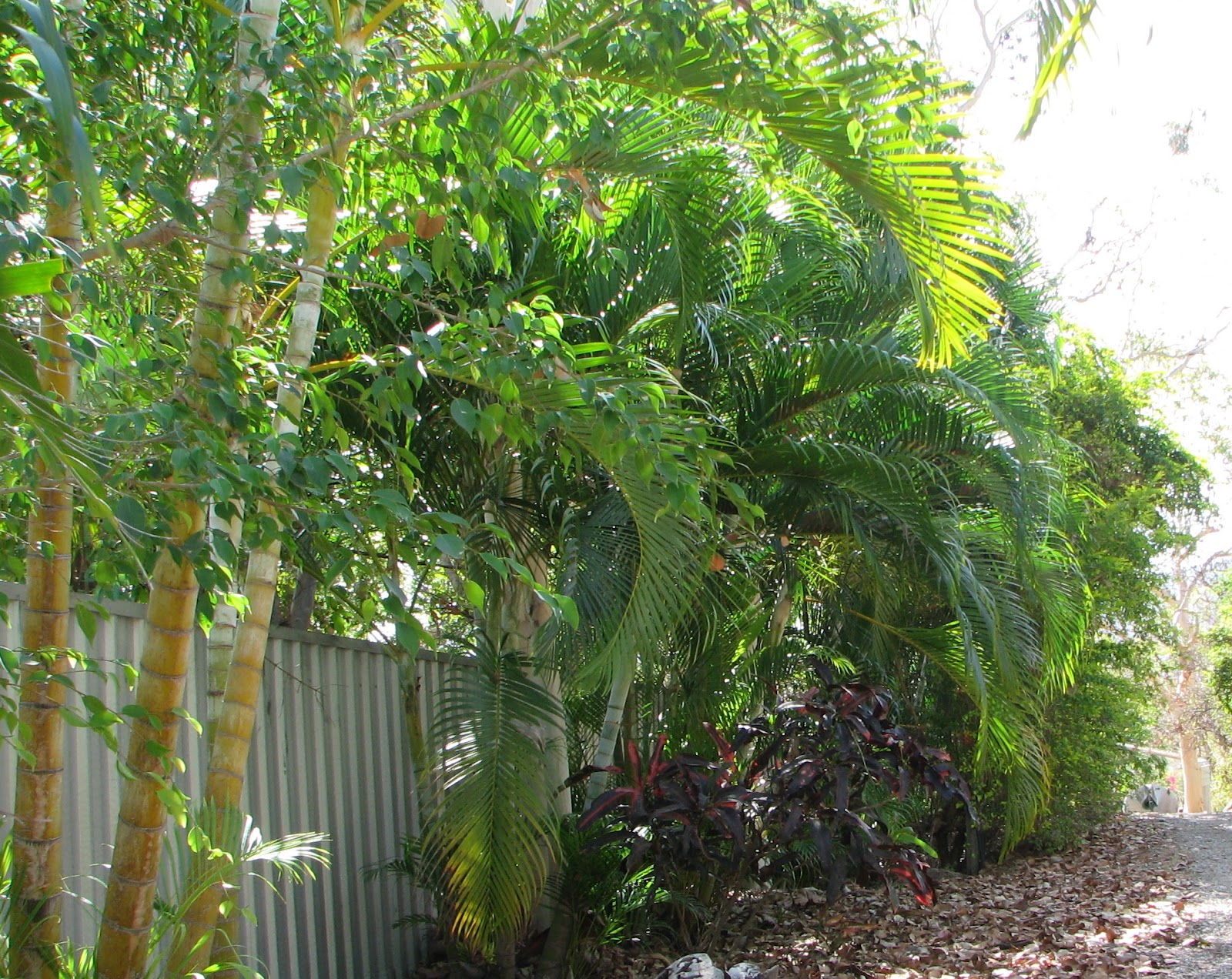
In other areas of the property, I use organic mulches.  In the long driveway garden beds there's always layers of leaves that have fallen from the many tall Eucalyptus trees on either side ... and it's just a matter of using the leaf blower to pile them up under all the shrubs ... as you can see clearly in the photo below.
In the newly established beds outside my greenhouse/shadehouse garden, I scatter dried sugar cane mulch all around the plants.  It's easily obtained here in my part of the world as we're so close to cane farms, thus it's a sustainable and renewable resource.
Here's a closer look at the sugar cane mulch ...

... the best feature of this mulching agent is that it doesn't become as compact and impenetrable as other organic mulches have a habit of doing here in the tropics.  It stays rather coarse and allows not only the rain to penetrate, but also fertiliser.  I've tried other types, but would never go back to them now.

One more great feature of this mulch, is that it's perfectly suited to areas that have a lot of run-off during the heavy summer rains.  This area of my property certainly has that ... as you can see from the bare patches in the lawn in the photo below, the run off from the torrential 'wet' season rainfall can be quite damaging.
I find that the dried cane sugar mulch used in those raised garden beds really knits together well and doesn't get washed away as easily as other mulches.

Pictured above is another of the areas that suffers from heavy summer rain run-off, and it's the roots of the huge Nephrolepis biserrata - the Giant Sword Fern - that mat together and hold the soil in place as the rainwater surges down the slope.  This fern, given lots of room, makes a beautiful low maintenance protective cover for areas that can be drastically eroded away by gushing rainfall.

Finally, one of the hardest parts of my garden to look after during our Summer is definitely the potted plants.
I have well over 100 pots, containers and hanging baskets in both my courtyard garden and my greenhouse/shadehouse garden.  Potted plants can be very demanding during hot summer weather.

Now while terracotta pots do indeed look fabulous, anything planted up in a terracotta pot will lose water very quickly here through evaporation.   Most of my potted plants are in plastic pots simply because they lose water less quickly.  I also make sure that the tops of all pots are mulched.  I use mostly bark chips as you can see in this potted Alocasia.
I also ensure every pot has water-retaining vermiculite added to the potting mix to help prevent water evaporating from the soil. 

Standing pots in groups in a semi-shaded, sheltered place also reduces evaporation.  This really helps many of my potted plants to get through our summer.

Hanging baskets need more water than pots on the ground.  Most of my hanging baskets and containers are in my greenhouse/shadehouse garden which is protected by shadecloth that blocks out 70% of the harsh sunlight ....
.... and is watered by a timed watering system. You can see the black irrigation pipes snaking along the top of the supporting poles.

Of course, with both hanging planters and pots it's never a good idea to water in the intense heat of the day ... the water will simply evaporate before your very eyes.  I always water very early in the morning before the sun has risen too high or I wait until the sun goes down ... and instead of a quickie every day, I give each plant a nice, deep drink every second day.  Far more beneficial!

Sunday, November 21, 2010

Impatiens hawkeri - New Guinea Impatiens


New Guinea Impatiens - Impatiens hawkeri - are one of my all-time favourite perennials.  They are so well suited to my dry tropics garden.  They're definitely sun-lovers, but many people are fooled into believing they can take full sun all day ... that is certainly not true here in the tropics.  During our fierce Summers, they will wither very quickly if subjected to a full day out in the blazing sunshine.


Yes it is true they are far more sun-loving than the other Impatiens species, such as Impatiens walleriana, but in my dry tropics garden during Summer, I have New Guinea Impatiens in positions where they can only enjoy direct morning sunlight.  In the Autumn-Winter though, they will sit out in full sun all day quite happily, as long as the roots are kept moist!

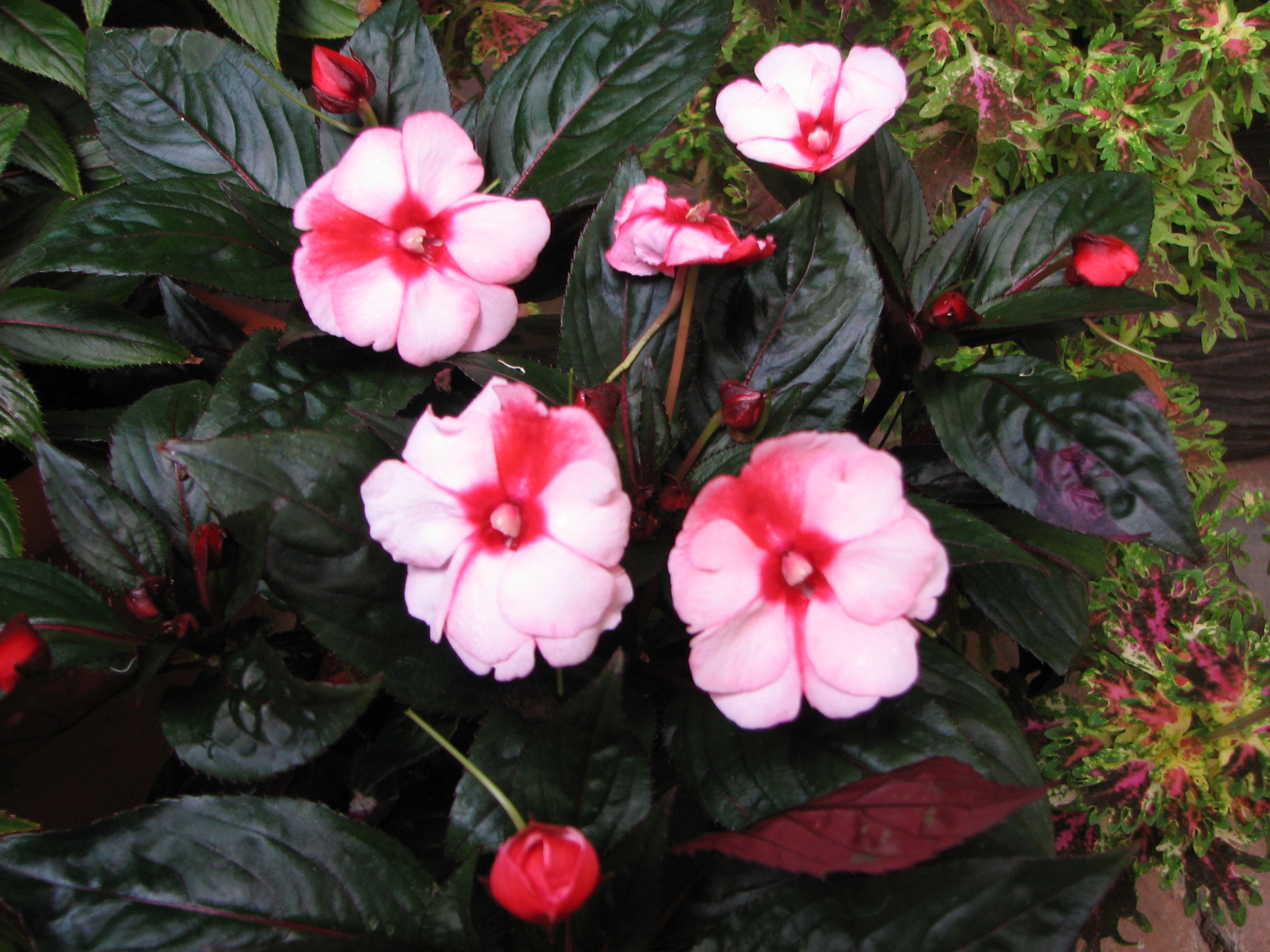
They form tight compact little bushes to around 45 cm in height and have great lance-shaped leaves that can vary from dark glossy green to bronze, and variegated as well.


They will flower continuously throughout the warmest months here, from late Spring right through to Autumn.  The single flattened flowers come in an amazing range of colours such as whites, pinks, reds, mauve and coral.  Sometimes the flowers can be up to 7 cms in diameter!

My favourite is definitely the white which really brightens up my Shadehouse Garden.

The red and orange Impatiens hawkeri have their own beauty though.


Some of the new cultivars have deep dark red veins running through the dark leaves and this makes handsome looking foliage.


They may also have fabulous variegated leaves with these dark red veins ...

... and have lovely two-tone flowers.

All my New Guinea Impatiens are in pots and are almost fuss-free plants in my garden.  I do have to take care with the watering, however.  They require a moist, well-drained soil.  Too wet and they will rot ... if they dry out, they will wilt quite badly!  Now while the wilted plant will recover quickly after watering, it's already suffered stress and will often drop all the flower buds and so have less flowers.  The leaves will also often drop and/or turn brown around the edges.  My potted New Guinea Impatiens love to be fertilised quite regularly with a water soluble fertiliser ... I always put some slow-release fertiliser in the potting mix as well. 

Thursday, November 11, 2010

Snapshots of mid-Spring ... which is October ... in my garden.

I began a 'Snapshots' post back in mid-Autumn and at the time I was planning to make it a regular part of my blog ... and then completely forgot all about it!!!  Rather typical of me ... but I like the idea I had back then so from now on I'm going to stick with it.  I will definitely be making regular mid-season posts about what's going on in my dry tropics garden Downunder.  But first I need to catch-up ... so I'm going to take a quick trip back in time to mid-Spring.

Conditions during October?
This past October was very different to many we've had in recent years.  It was wetter, slightly cooler and we had many, many overcast days.  There were quite a few days when we received very light showers, but the rain barely touched the ground.  We did, however, have around a week of heavier rainfall and the total for the month got up to around 50mm (almost 2 inches)!  Now that may not sound like much, but in the dry tropics that's way out of the ordinary for mid-Spring.

The weather patterns were almost identical to those I wrote about in  Snapshots of mid-Autumn - the unusual lack of bright sunshine and the missing-in-action clear blue-sky days continued to affect the patterns in my garden.

(Note:  My garden differs from many as it does not contain lots of flower beds or borders.  I feel I need to make this point almost every time I post ... to explain the lack of colourful garden bed shots).

Starting with the trees on our property ... what was flowering?

The Bauhinia variegata 'Alba' was still showing a few blooms during September, our beginning of Spring month and then quite a few more appeared during October.  This was definitely not the usual pattern for this winter bloomer.


The Corymbia torelliana or Cadaghi Gum was in bloom ... it was blooming on schedule but there were more flowers this year.

The Cocky Apple trees were blooming up a storm during October.  There are dozens of them in the bushland surrounding our home and there's a couple on the property itself ... and this October there were abundant blooms, more than I've ever seen before.  This is a tree native to our corner of Oz and it's not a tree that's well-known because it has never been cultivated for general nursery sales.

This was the month that my Jacaranda mimosifolia started blooming.  Mine seems to start later than all the others in my neighbourhood ... and it seems to be that way every year for whatever reason!  It's also a very sparse bloomer ... more to do with its location than anything else, I suspect ... but I still appreciate every little cluster of these gorgeous lavender flowers.

Next ... out in the Courtyard Garden, what was flowering?
Lots of my potted plants out in the Courtyard Garden were in full bloom.  I had quite a bit of trouble with some of the annuals this year ... like the Petunias ... as well as the Pansies and Violas.   I think that was a direct consequence of all the overcast dreary days we had ... just not enough sunshine this year.

The star performer of all the annuals though, was the Snapdragon.


Other potted plants that did very, very well -
Crossandras, Pelargoniums, Bracteantha bracteatas and Gazanias ...

... Angelonias, Azaleas, Salvia spelendens, Calibrachoa and miniature Zinnias.

... New Guinea Impatiens, the 'Caliente' hybird Pelargonium peltatums and Plectranthus.

This year I also had a couple of pots of Oriental lilies ... first time ever for me and I was very, very pleased with them.

Now ... which shrubs around the property were flowering?

The shrubs that were back in bloom included the Calliandras ... a very strange turn of events.  This year these shrubs bloomed for almost two months longer than they normally do ... there were even a few flowers still hanging on just a week or so ago.  These are usually Winter bloomers for me.

The Durantas started to flower again ... they take turns throughout the year, but the old reliable Big Mama always starts first and she was true to form again this year.  She is the tallest of all the Durantas and always has the darkest flowers.

Last of all ... what was blooming out in the Greenhouse or Shadehouse garden?

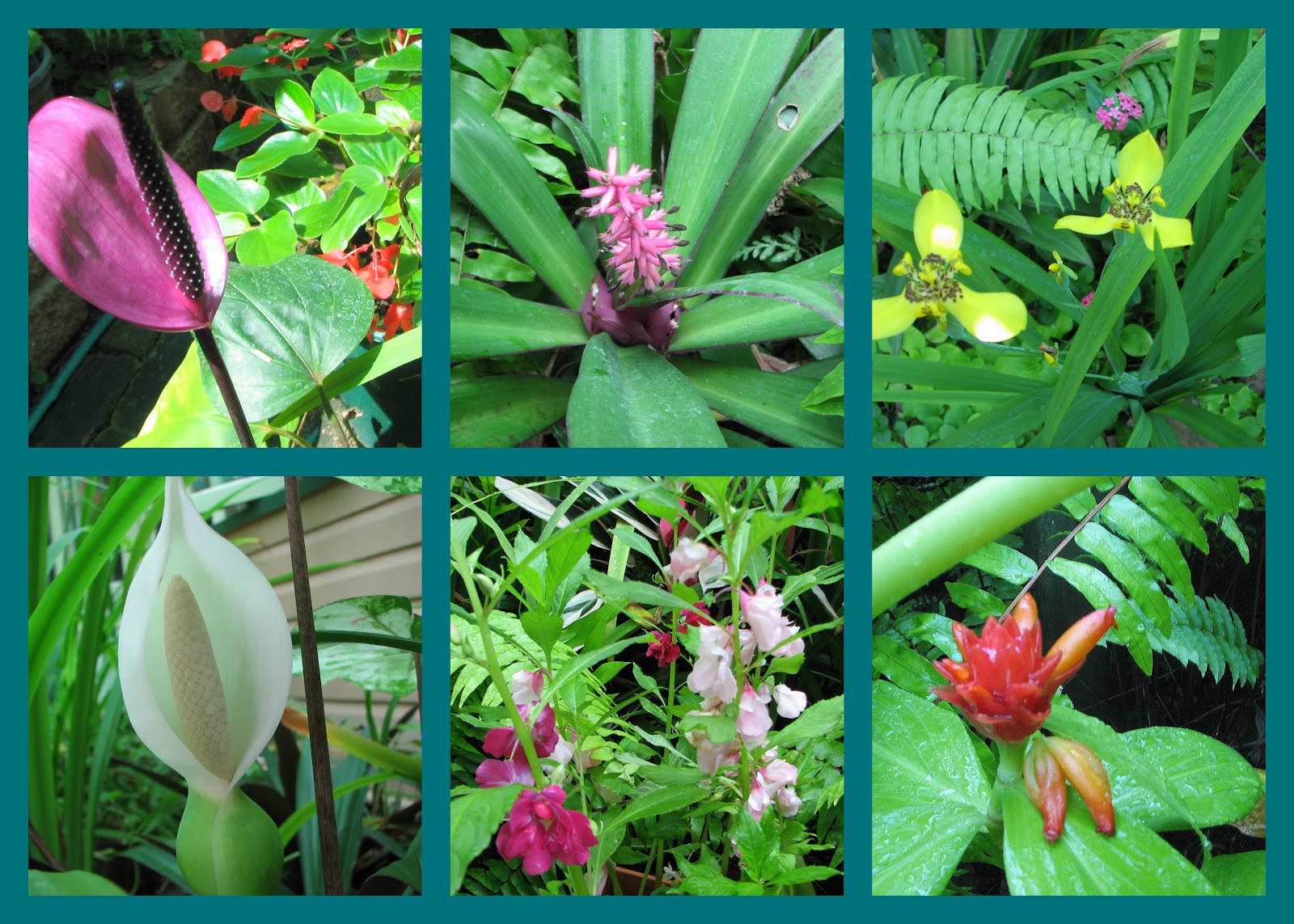
Anthurium, Bromeliad, Neomarica, Caladiums, Impatiens balsamina, Spiral Ginger ....

.... Coleus, Evolvulus, Barleria and Begonias.

I had a pot of Asiatic lilies out in the Shadehouse Garden ... and these were a first for me as well this year.
That was the state of play in the garden during mid-Spring this year.